
Gunung Kawi Temple is one of Bali’s most remarkable archaeological and cultural sites, located in the lush valley of the Pakerisan River in Tampaksiring, Gianyar. Unlike many Balinese temples, the site is famous for enormous shrines carved directly into the rock cliffs. Built during the 11th century, the complex is closely associated with King Anak Wungsu and the royal family of the Warmadewa dynasty. Today, visitors come to see the ancient monuments, walk through rice terraces, explore the river valley, and experience a sacred landscape that remains connected to Balinese religious traditions.
If you are planning a cultural trip from Ubud, Gunung Kawi is one of the most interesting historical sites to include in your itinerary. This guide explains the history, architecture, entrance fee, opening hours, number of steps, location, how to get there, temple etiquette, and the important difference between Gunung Kawi Tampaksiring and Gunung Kawi Sebatu.
Quick Facts About Gunung Kawi Temple
| Information | Details |
| Location | Banjar Penaka, Tampaksiring, Gianyar, Bali |
| Historical period | 11th century |
| Distance from Ubud | Approximately 15 km north of central Ubud |
| Steps | About 315 steps are commonly counted on the main descent |
| Foreign visitor entrance fee | Around IDR 50,000 according to current tourism information |
| Opening hours | Commonly listed around 08:00 to 18:00 WITA |
| Recommended visit | Morning or early afternoon |
| Dress | Modest clothing, sarong and sash where required |
Entrance fees and opening hours can change, so visitors should confirm the latest information locally before traveling. Indonesia Travel currently lists IDR 50,000 for international visitors and IDR 30,000 for domestic visitors, with daily opening hours listed from 08:00 to 18:00 WITA.
What Is Gunung Kawi Temple?
The name gunung kawi temple generally refers to the ancient Candi Gunung Kawi complex in Tampaksiring. It is not simply a conventional Balinese temple building. Instead, the site combines monumental rock carvings, shrines, a functioning sacred area, ancient bathing features, and a dramatic natural landscape.
You may also see the names temple gunung kawi, pura gunung kawi temple, candi gunung kawi temple, or gunung kawi bali temple used to describe the destination.
The site is officially recognized as an important archaeological attraction in Gianyar. The Gianyar tourism authority describes Gunung Kawi as an archaeological site carved into the sandstone cliff beside the Pakerisan River.
For travelers searching for a temple in Tampaksiring, Gunung Kawi is one of the most significant places to visit because it combines ancient royal history with living Balinese spirituality.
Where Is Gunung Kawi Temple?
Gunung Kawi is located in Banjar Penaka, Tampaksiring District, Gianyar Regency, Bali. The Gunung Kawi temple location places it in the Pakerisan River valley, surrounded by rice terraces, tropical vegetation, and steep valley walls.
The location is especially convenient for travelers staying in Ubud. Gunung Kawi is approximately 15 km north of central Ubud, and the journey commonly takes around 30 to 40 minutes depending on traffic and the starting point.
This makes Gunung Kawi a practical temple near Ubud and an excellent option for travelers looking for a historical temple near Ubud without traveling to the eastern or southern parts of Bali.
What Is the History of Pura Gunung Kawi Tampaksiring?
The history of Pura Gunung Kawi Tampaksiring goes back to the 11th century during the reign of King Anak Wungsu, one of the rulers of the ancient Balinese kingdom.
According to the Gianyar tourism authority, Anak Wungsu was the son of King Udayana and Queen Gunapriya Dharmapatni. The royal family included Airlangga, Marakata, and Anak Wungsu. After Marakata, Anak Wungsu ruled Bali from approximately 1049 until 1080. The rulers were later commemorated at Gunung Kawi.
Indonesia Travel also dates the construction of the complex to the 11th century and associates the monuments with King Anak Wungsu and the Warmadewa dynasty.
This makes Gunung Kawi far more than a scenic attraction. It is an important window into Gunung Kawi Bali history, ancient Balinese royal traditions, and the development of monumental architecture on the island.
Gunung Kawi and the Udayana Dynasty
The monuments are strongly connected with the royal family of the Warmadewa dynasty. Historical interpretations vary regarding exactly which monument commemorates which member of the royal family.
The Gianyar tourism authority notes inscriptions at the site that have been used to support interpretations concerning King Udayana and his descendants.
Because some details remain matters of historical interpretation, it is better to describe the monuments as royal memorials associated with the dynasty rather than presenting every individual identification as an absolute fact.
Gunung Kawi Archaeological Site and Its Rock-Cut Shrines
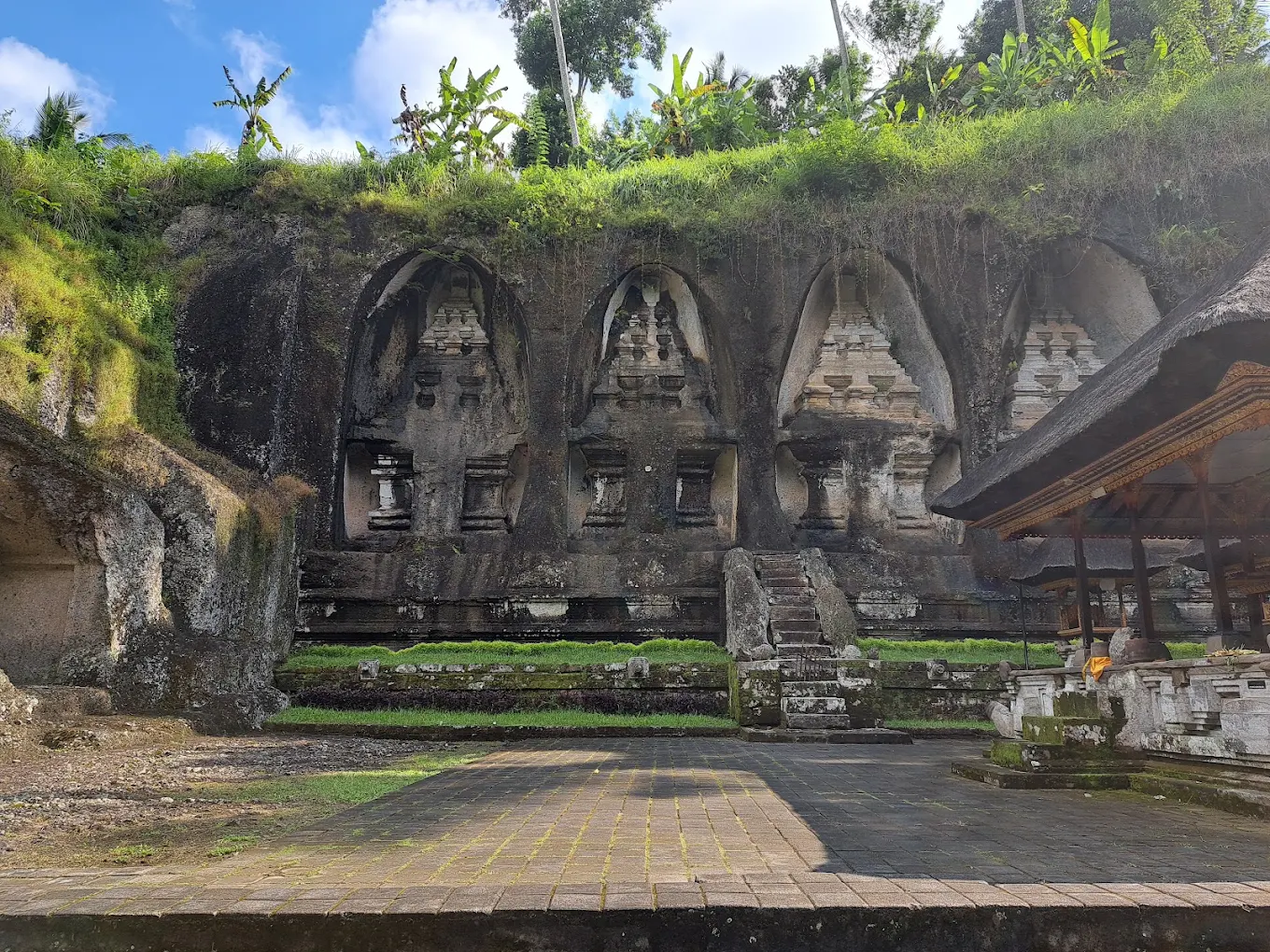
The Gunung Kawi archaeological site is famous for its monumental shrines carved directly into the cliff face.
The complex contains ten principal rock-cut monuments, arranged in groups on opposite sides of the Pakerisan River. These are often described as memorials or shrines rather than conventional tombs.
The Gunung Kawi rock-cut shrines imitate the appearance of free-standing temple structures but were carved directly into the natural cliff. This technique makes the site very different from most other temples in Bali.
The Gunung Kawi monuments rise dramatically from the cliff walls, creating one of the most distinctive archaeological landscapes in Indonesia.
Indonesia Travel describes the principal complex as ten shrines carved into the rock cliff, with the monuments reaching several metres in height.
Gunung Kawi Architecture
The Gunung Kawi architecture is one of the main reasons historians, photographers, and cultural travelers visit the site.
Rather than constructing the monuments from separate blocks of stone, ancient craftsmen carved the forms directly into the cliff. This created a group of monumental structures that appear to emerge from the rock itself.
The Gunung Kawi rock carvings show remarkable craftsmanship. Their form is influenced by the architectural traditions of ancient Java while being integrated into Bali’s natural and spiritual environment. Indonesia Travel notes similarities between the candi forms at Gunung Kawi and free-standing ancient candi traditions in East Java.
The result is a rare combination of:
- Rock-cut architecture
- Ancient Hindu architectural traditions
- Royal memorials
- Balinese spiritual practices
- Natural river landscapes
- Archaeological monuments
For anyone interested in Hindu architecture Bali, Gunung Kawi provides an unusually powerful example of how architecture can be shaped directly from the landscape.
Candi Gunung Kawi and the Ancient Royal Memorials
The terms Candi Gunung Kawi, Candi Gunung Kawi Tampaksiring, and Gunung Kawi candi are commonly used when discussing the archaeological monuments.
The word candi in this context refers to the monumental shrine structures carved into the cliff. They are different from the typical temple compounds visitors may see elsewhere in Bali.
The site can therefore be understood as an ancient candi Bali complex and an archaeological monument connected with Bali’s ancient royal history.
The monumental structures are sometimes described as royal memorial sites or royal tombs Bali, although the term “tomb” can oversimplify their religious and commemorative function.
Their real significance lies in the combination of royal commemoration, sacred tradition, architecture, and the landscape of the Pakerisan River valley.
How Many Steps Are There at Gunung Kawi Temple?
One of the most common questions from travelers is: How many steps are there at Pura Gunung Kawi Tampaksiring?
The answer commonly given is about 315 stone steps from the entrance area down toward the main complex.
Some official tourism descriptions simply describe the route as approximately 300 steps, while other current travel references count around 315 steps.
The important thing to remember is that you need to walk the route in both directions. The descent is relatively manageable for most visitors, but the return climb can be tiring, especially in Bali’s warm and humid conditions.
The staircase passes through a beautiful landscape of rice terraces, tropical vegetation, small shops, and the green valley leading toward the Pakerisan River.
Wear comfortable shoes, bring drinking water, and allow enough time for breaks.
Gunung Kawi Temple Entrance Fee
How Much Is Gunung Kawi Temple?
The gunung kawi temple entrance fee can change, so visitors should check the latest price before arriving.
Current tourism information from Indonesia Travel lists:
- International visitors: approximately IDR 50,000 per person
- Domestic visitors: approximately IDR 30,000 per person
The local tourism information site also lists IDR 50,000 for foreign visitors and IDR 30,000 for domestic visitors.
Therefore, the Gunung Kawi entrance fee, Gunung Kawi admission fee, and Gunung Kawi entry fee should be treated as current reference prices rather than permanent rates.
Gunung Kawi Ticket Price and Admission
If you search online for the Gunung Kawi ticket price, you may find different figures because entrance fees can change over time and different websites may update at different times.
The Gunung Kawi temple ticket normally covers entry to the attraction, while parking and optional services may be separate.
For this reason, travelers should carry some cash and confirm the current rate at the official ticket counter.
In short, Gunung Kawi Temple price information currently available from official tourism sources indicates around IDR 50,000 for foreign visitors.
Gunung Kawi Opening Hours
The Gunung Kawi opening hours are commonly listed as daily from around 08:00 to 18:00 WITA by Indonesia Travel.
Some local information lists tourist activities from 07:00 to 18:00, so opening times may vary depending on the source and current local arrangements.
For the best experience, arriving in the morning is recommended. The temperature is usually more comfortable, the staircase is easier to walk, and the valley tends to feel quieter.
The Gunung Kawi visiting hours are also worth considering if you plan to combine the site with Tirta Empul, Tegallalang, or other attractions around Tampaksiring.
How to Get to Gunung Kawi
How to Get to Gunung Kawi
If you are wondering how to get to Gunung Kawi, the easiest option for most international visitors is traveling by private car with a driver or joining a guided tour. Travelers planning several cultural attractions can also use an Ubud travel guide to understand the best routes and places to combine around the area.
From central Ubud, the route takes you north toward Tampaksiring. The journey usually takes around 30 to 40 minutes, depending on traffic.
Gunung Kawi from Ubud
The journey from Gunung Kawi from Ubud is relatively straightforward. Travelers can use a private car, taxi, scooter, or organized tour.
For visitors unfamiliar with Bali roads, a private driver can be more comfortable because the driver can also combine several attractions into one itinerary.
The Ubud to Gunung Kawi route is particularly popular because several important cultural attractions are located nearby.
A typical day could combine:
- Gunung Kawi Temple
- Tirta Empul Temple
- Tegallalang Rice Terrace
- Goa Gajah
- Ubud village or other cultural attractions
What to See at the Gunung Kawi Temple Complex
The Gunung Kawi temple complex is larger than the famous cliff carvings alone.
Visitors can explore the main monuments, river valley, traditional temple areas, stone pathways, ancient bathing areas, and surrounding rice terraces.
The Gunung Kawi sacred site remains connected to Balinese religious life. It is therefore important to remember that this is not simply an archaeological attraction.
You may see offerings, ceremonies, local worshippers, and other signs of living Balinese Hindu traditions.
The combination of archaeology and living religion is what makes Gunung Kawi particularly meaningful.
Is Gunung Kawi a Temple or an Archaeological Site?
It is both a cultural and archaeological destination and a sacred religious landscape.
The famous cliff monuments are generally referred to as candi, while the functioning temple area is known locally as Pura Gunung Kawi.
Indonesia Travel distinguishes between the rock-cut candi monuments and the functioning temple courtyard across the river.
This explains why visitors may encounter several names online, including Pura Gunung Kawi, Gunung Kawi Pura, and Gunung Kawi temple Bali.
The names can refer to related parts of the same broader sacred complex.
Gunung Kawi Sebatu vs Gunung Kawi Tampaksiring
One of the most important things to understand before visiting is that Gunung Kawi Tampaksiring and Gunung Kawi Sebatu are different places.
What Is Gunung Kawi Sebatu?
The gunung kawi sebatu temple is commonly associated with the sacred water temple in Sebatu village, north of Ubud.
It is also known as the Gunung Kawi Sebatu Water Temple or Sebatu Water Temple.
Unlike the cliff-carved monuments at Tampaksiring, this destination is known for its water features, ponds, springs, and peaceful temple environment.
Gunung Kawi Sebatu Water Temple
The Gunung Kawi Sebatu Water Temple offers a different type of cultural experience.
Its identity is strongly connected with water, purification, and the natural environment.
Visitors may encounter:
- Holy spring water
- Natural spring features
- Sacred bathing pools
- Water purification traditions
- Balinese purification ceremony
- Traditional temple courtyards
- Tropical gardens
- Peaceful water features
This is why it is often described as a sacred water temple, Balinese water temple, or water temple near Ubud.
Pura Gunung Kawi Sebatu Temple
The name pura gunung kawi sebatu temple can be confusing for first-time visitors because it sounds almost identical to Gunung Kawi Tampaksiring.
Likewise, you may see the phrase temple pura gunung kawi sebatu when searching for the water temple.
For your Bali itinerary, always check whether your driver or tour operator means:
Gunung Kawi Tampaksiring, the ancient rock-cut archaeological complex,
or
Gunung Kawi Sebatu, the peaceful water temple.
The Gunung Kawi Sebatu Temple Bali experience is especially suitable for travelers interested in water, purification, and a quieter spiritual environment.
Gunung Kawi Sebatu and the Ubud Area
Gunung Kawi Sebatu is a temple near Tegallalang and is often included in cultural routes around northern Ubud.
Travelers interested in a spiritual temple near Ubud may enjoy visiting Sebatu because of its calm atmosphere and connection with water.
The area around Sebatu village also provides a more rural perspective of Bali, away from some of the busier tourist centers.
If your priority is ancient architecture and royal history, choose Gunung Kawi Tampaksiring.
If your priority is water, purification, and a peaceful natural setting, Gunung Kawi Sebatu may be more suitable.
What About Batuan Temple and Gunung Kawi?
Travelers sometimes search for batuan temple gunung kawi because they are looking for a route that combines several cultural attractions in Bali.
However, Batuan Temple and Gunung Kawi are separate destinations.
Batuan Temple is located south of Ubud, while Gunung Kawi is in Tampaksiring. They can be combined into a private Bali itinerary, but they should not be described as the same temple or archaeological complex.
This distinction is important when planning a temple tour in Ubud and when using Google Maps.
Gunung Kawi Dress Code and Temple Etiquette
Gunung Kawi is a sacred Balinese religious site, so visitors should dress respectfully.
A sarong and sash are generally required when entering sacred areas. Indonesia Travel notes that appropriate temple attire is required and that sarongs and sashes are available around the entrance area.
Visitors should also:
- Cover their shoulders and knees
- Follow instructions from temple staff
- Avoid entering restricted areas
- Do not climb on the ancient monuments
- Do not touch or damage carvings
- Avoid loud behavior
- Never step over offerings
- Do not point your feet toward sacred objects
- Ask permission before photographing ceremonies or worshippers
Remember that Gunung Kawi is a Balinese temple, Hindu temple Bali destination, and an active sacred environment rather than simply a tourist attraction.
Best Time to Visit Gunung Kawi Temple
The best time to visit is generally early in the morning.
Morning visits offer several advantages:
- Cooler temperatures
- Better conditions for walking the steps
- Softer light for photography
- More peaceful surroundings
- More comfortable exploration of the valley
The wet season can make the stone steps slippery, so good footwear is especially important after rain.
If you are sensitive to heat, avoid visiting around the hottest part of the day because the climb back toward the entrance can be physically demanding.
How Long Do You Need at Gunung Kawi?
Most travelers should allow approximately 1 to 2 hours for a relaxed visit.
This gives you enough time to:
- Walk down to the valley
- Explore the monuments
- Cross the river area
- Visit the sacred temple areas
- Take photographs
- Learn about the history
- Walk back up the steps
Visitors who enjoy photography or want to explore slowly may want additional time.
Why Gunung Kawi Is Worth Visiting
Gunung Kawi is different from many famous Bali attractions because the experience begins before you even reach the monuments.
The long descent takes you away from the road and into a green river valley. Rice terraces appear along the route. The sound of water becomes stronger as you approach the Pakerisan River.
Then the massive cliff-carved monuments appear.
This gradual transition from modern Bali into an ancient landscape is one of the strongest parts of the experience.
The site is not simply about taking photographs. It provides an opportunity to understand the relationship between Bali’s royal history, religion, architecture, water, agriculture, and landscape.
Gunung Kawi Temple vs Other Temples Near Ubud
Gunung Kawi can easily be combined with other cultural destinations in the Ubud and Tampaksiring area.
Tirta Empul Temple
Tirta Empul is famous for its sacred spring water and purification tradition. It is particularly suitable for travelers interested in Balinese water rituals.
Tegallalang Rice Terraces
Tegallalang provides a strong contrast to Gunung Kawi. Instead of ancient royal monuments, visitors experience Bali’s agricultural landscape and rice terrace traditions.
Goa Gajah
Goa Gajah is another important archaeological site near Ubud. Its distinctive cave entrance, stone carvings, bathing pools, and surrounding landscape make it a natural addition to a cultural itinerary.
Batuan Temple
Batuan Temple is another important Balinese temple that can be combined with other cultural sites, although it is located in a different area from Gunung Kawi.
Planning a Gunung Kawi Temple Tour
Travelers who want to visit multiple cultural sites can organize a private itinerary around Tampaksiring and Ubud. An ubud tour package can be a convenient option for visitors who want to combine Gunung Kawi with Tirta Empul, Tegallalang, Goa Gajah, and other attractions in one day.
A well planned route may include Gunung Kawi, Tirta Empul, Tegallalang, Goa Gajah, and other attractions.
For visitors who want historical context, hiring a local guide can make the experience much more meaningful. A guide can explain the royal history, religious symbolism, architecture, and traditions that are not immediately obvious when walking through the complex.
A private driver is also useful because the area contains several attractions that can be combined efficiently.
Frequently Asked Questions
What is the history of Pura Gunung Kawi Tampaksiring?
Pura Gunung Kawi Tampaksiring dates to the 11th century and is associated with King Anak Wungsu and the Warmadewa royal dynasty. The complex contains monumental shrines carved directly into the cliffs beside the Pakerisan River. Historical interpretations connect the monuments with members of the Balinese royal family, including King Udayana and his descendants.
How much is the entrance fee to Gunung Kawi Tampaksiring?
Current tourism information lists approximately IDR 50,000 for international visitors and IDR 30,000 for domestic visitors. Because entrance fees can change, it is advisable to confirm the latest price before visiting.
How many steps are there at Pura Gunung Kawi Tampaksiring?
The main route contains approximately 315 stone steps. Some official descriptions round the number to around 300 steps, while other current references give 315. Visitors need to walk down to the valley and climb back up after exploring the complex.
Where is Gunung Kawi Temple located?
Gunung Kawi is located in Banjar Penaka, Tampaksiring District, Gianyar Regency, Bali, beside the Pakerisan River.
How far is Gunung Kawi from Ubud?
Gunung Kawi is approximately 15 km north of central Ubud. The drive commonly takes around 30 to 40 minutes, depending on traffic and your exact starting point.
Is Gunung Kawi the same as Gunung Kawi Sebatu?
No. Gunung Kawi Tampaksiring is an ancient archaeological complex famous for rock-cut royal shrines. Gunung Kawi Sebatu is a separate water temple associated with springs, water features, and purification traditions.
Is Gunung Kawi difficult to visit?
The site is accessible to most reasonably mobile travelers, but the approximately 315-step descent and ascent require some physical effort. Comfortable shoes, water, and sufficient time are recommended.
Final Thoughts
Gunung Kawi Temple is one of Bali’s most fascinating places for travelers who want to go beyond beaches and famous viewpoints.
Its combination of 11th century royal history, rock-cut architecture, ancient monuments, sacred traditions, rice terraces, and the Pakerisan River valley makes it a unique cultural destination.
For travelers staying in Ubud, the relatively short journey makes it an excellent addition to a Bali cultural itinerary. Just remember that Gunung Kawi Tampaksiring and Gunung Kawi Sebatu are different destinations.
If you are interested in ancient Balinese history, architecture, archaeology, or spirituality, Gunung Kawi deserves a place on your itinerary. Take your time walking down the steps, look closely at the cliff carvings, respect the sacred areas, and allow the landscape to become part of the experience.
The most valuable part of visiting Gunung Kawi is not simply seeing an ancient monument. It is understanding how Bali’s history, religion, royal traditions, water, agriculture, and natural environment have remained connected for centuries.